

USB Flash Drive Recovery — Thumb Drive, USB Stick & Portable USB Storage
Last Updated:
USB drive not working? Stop plugging it in and act now — the first move decides whether your files survive.
✔ Free file list before you pay · ✔ Free phone assessment · ✔ ISO-5 Class 100 clean room · ✔ 20+ years experience
USB flash drives are the world’s most casualty-prone storage device — they’re small, unprotected, constantly moved around, and often the only copy of important data. Whether your USB stick is not recognised, snapped in half, showing as RAW, or simply isn’t showing any files after being dropped or mishandled, The Original PC Doctor recovers data from USB flash drives of all brands, capacities and damage types.
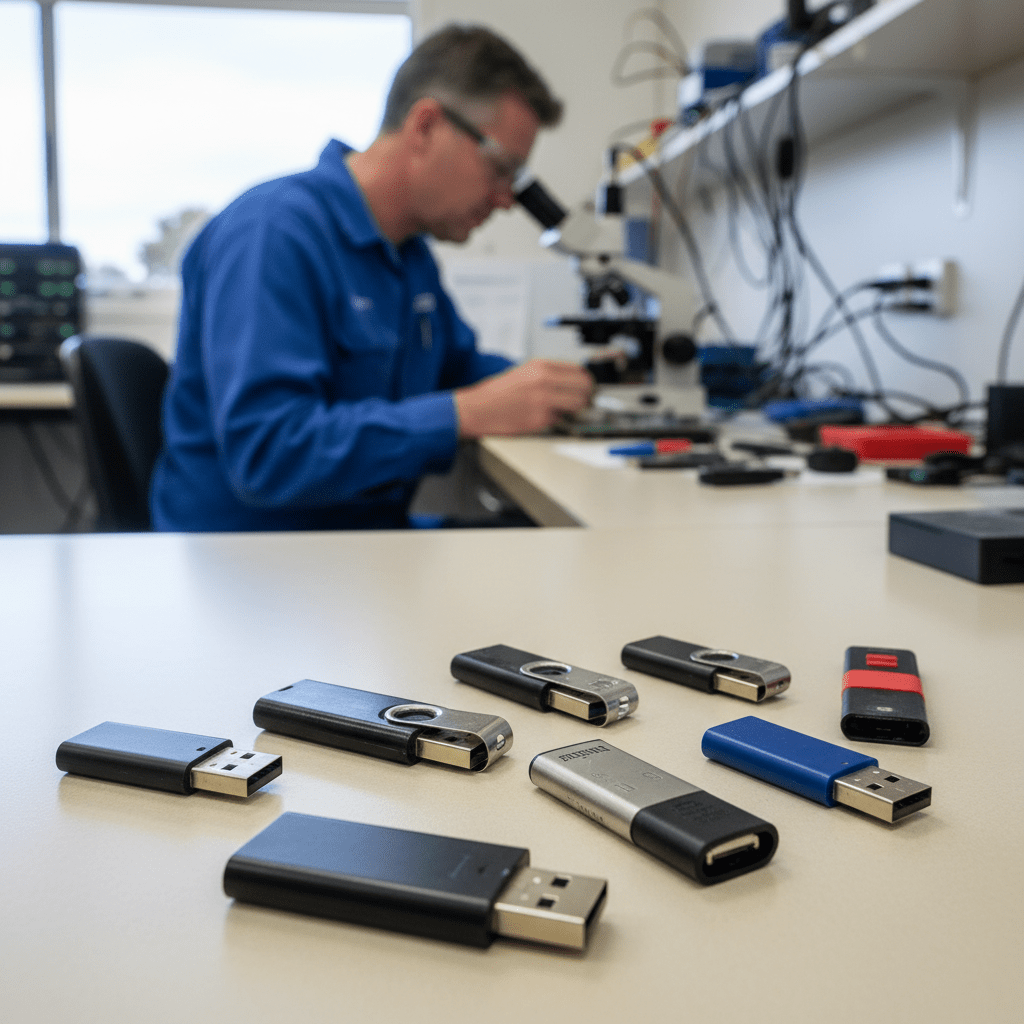
Unlike hard drives, USB flash drives use NAND flash memory chips — the same technology as SSDs. This means some recovery techniques are very different, and physical damage that looks catastrophic (a snapped USB connector, a cracked housing) often leaves the NAND chip intact and fully recoverable.
USB drive failed? Call 1300 723 628 — free assessment, all brands.
USB Flash Drive Brands We Recover From
We also recover from encrypted USB drives including Kingston IronKey, Apricorn Aegis, iStorage datAshur, and hardware-encrypted corporate compliance drives — provided you can supply the PIN or password.

USB Flash Drive Failure Scenarios
- “Please insert disk into drive” or “USB device not recognised” in Windows — the drive is being detected at the USB level but the file system or partition table is not readable. Data is typically intact.
- Drive shows as “RAW” in Windows Disk Management — the file system is corrupted or unrecognised. Do not format — files are still there.
- Drive shows up but appears empty or shows wrong capacity — partition damage or volume metadata corruption. Files are on the drive but the operating system can’t see them.
- Files disappeared after the USB was ejected improperly — unsafe removal while writing can corrupt the file allocation table, making files invisible without destroying the underlying data.
- Accidental deletion or format of USB drive — 90–99% recovery rate on formatted or deleted-from flash drives, provided you stop writing to the drive immediately.
- USB drive shows correct capacity but all folders are empty or shortcuts — sometimes caused by a virus hiding files using the “attrib” command. We restore hidden files and remove the virus.
- USB drive gets very hot, burning smell, visible scorch marks — electrical fault or short circuit on the PCB. The NAND chip may survive. Do not use the drive again — bring it in for assessment.
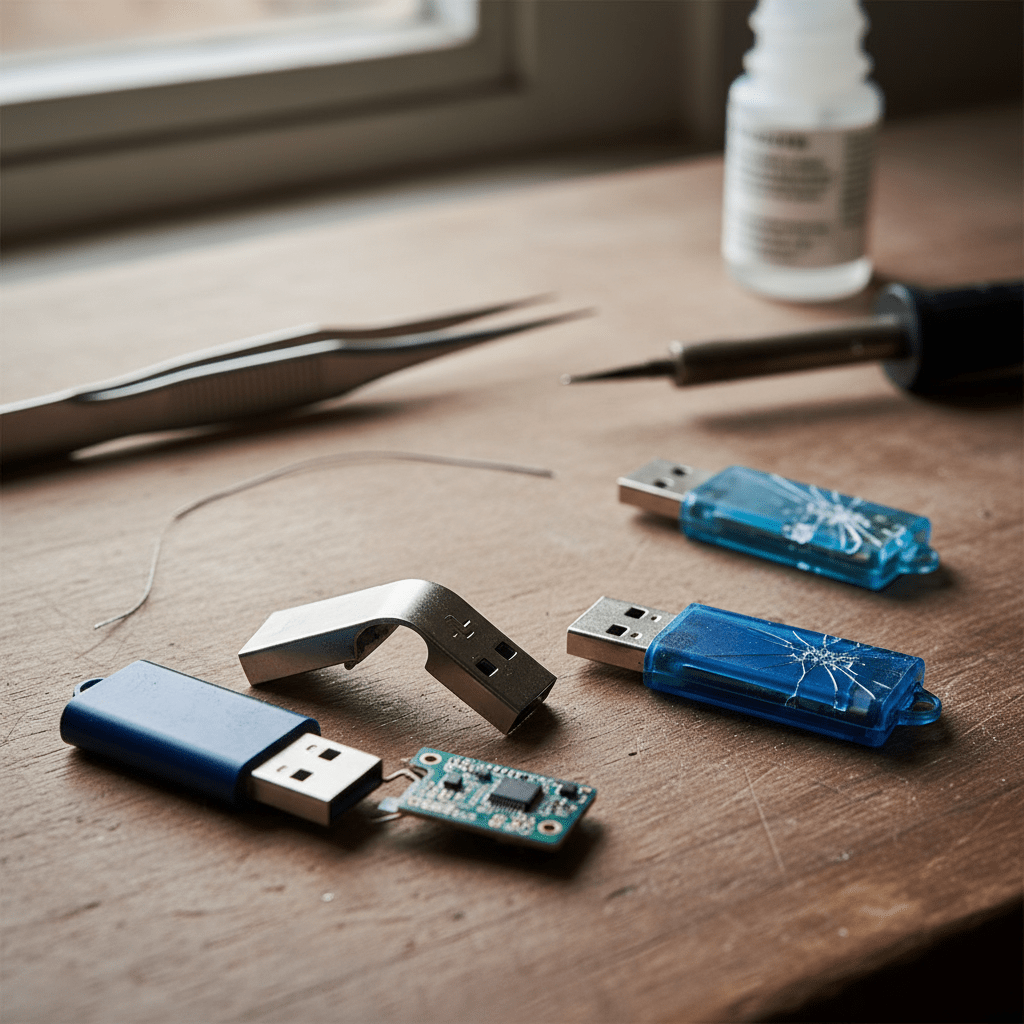
- USB connector physically broken or snapped — the most common physical failure we see. The USB connector breaks off the PCB, leaving the NAND chip and controller intact inside the plastic casing.
- USB drive was washed in a washing machine or dropped in liquid — flash drives can survive liquid damage better than hard drives. Dry the casing without powering on, then bring it in.
- Drive was bent, crushed or run over — provided the NAND chips on the PCB are not cracked, we can often recover data via chip-off extraction.
Physical Damage — Chip-Off Recovery
When a USB flash drive is physically destroyed to the point where it cannot be connected to a computer, our engineers perform chip-off recovery — a technique where the NAND flash memory chip is carefully desoldered from the broken PCB and read directly on specialist chip reader hardware.
Chip-off recovery bypasses the failed controller chip entirely and reads the raw NAND data directly. The data then needs to be de-XORed and descrambled based on the specific controller model used in the drive. We maintain a database of controller algorithms for the most common flash drive controller chips (Phison, SMI, Silicon Motion, Innostor, Alcor, JMicron) to reconstruct data from raw NAND dumps.
If your USB connector snapped off and the casing cracked, the NAND chip inside is often completely undamaged. These are some of our most successful physical recovery cases — the data is intact, we just need to read it differently. Call us before disposing of any broken USB drive.
What To Do Right Now
Force a non-recognised USB drive into the port repeatedly — this can cause further PCB damage. Try to bend a snapped USB connector back into place. Run recovery software and save recovered files back to the same USB drive. Format the drive when Windows asks you to.
Stop using the drive immediately. If physically broken, place it in a small zip-lock bag to keep all pieces together. Do not attempt to remove the NAND chip yourself. Call 1300 723 628 for a free assessment.
Our Recovery Process
- Free assessment — describe the brand, capacity, what happened, and what files you need. We’ll give you a diagnosis and price range immediately.
- Physical inspection — we inspect the PCB, connector, controller chip and NAND chips under magnification before attempting any connection.
- Connection or chip-off — if the USB connector is intact and the controller responds, we image the drive directly. If the controller is failed or the connector is broken, we perform chip-off extraction of the NAND chip(s).
- Data reconstruction — raw NAND data is descrambled and reassembled into a usable disk image using controller-specific algorithms.
- File system recovery and delivery — we extract the file system from the reconstructed image and deliver recovered files on a new USB drive, hard drive, or via secure cloud transfer.
Free Resources
Independent, non-commercial references on USB flash storage and data loss:
Get your files off that USB — free file list, free phone assessment. Talk to a specialist today.
✔ Free file list before you pay · ✔ Free phone assessment · ✔ ISO-5 Class 100 clean room · ✔ 20+ years experience
Our Data Recovery Specialties
We recover from every device and failure type — go straight to the specialist service you need:
- Hard drive data recovery
- SSD data recovery
- USB flash drive recovery
- SD & memory card recovery
- RAID & NAS recovery
- Email & Outlook PST recovery
- Ransomware data recovery
- Photo recovery
- External hard drive recovery
- iPhone & smartphone recovery
- Mac & MacBook recovery
- Emergency & same-day recovery
- Business & server recovery
FAQs — USB Flash Drive Recovery
How much does USB flash drive recovery cost?
Logical recovery (format, deletion, RAW filesystem) typically starts at $200–$400 AUD. Physical recovery requiring chip-off extraction typically ranges from $500–$1,200 depending on the drive capacity and complexity of the NAND descrambling required. We provide a fixed quote before any work begins. Call 1300 723 628.
Can you recover from a USB drive that snapped in two?
Yes, in most cases. When a USB drive snaps, the break usually occurs at the USB connector — the weakest mechanical point. The NAND chip, which is located deeper in the PCB, is typically undamaged. We perform chip-off extraction to read the NAND chip directly. Bring all pieces of the broken drive — nothing should be thrown away.
My USB shows “You need to format the disk” — should I format it?
No. This message appears when Windows cannot read the file system but the data is still physically present on the drive. Formatting would erase the file system index, making recovery slightly more complex (though still possible in most cases). Instead, stop using the drive and call us for a free assessment.
Can you recover from an encrypted USB drive (IronKey, datAshur)?
Yes — if you can supply the PIN or password. Kingston IronKey, Apricorn Aegis, iStorage datAshur and other hardware-encrypted drives use AES-256 encryption at the hardware level. If the controller chip has failed, we recover the encrypted data and then decrypt it using your credentials. Without the correct PIN/password, the encryption cannot be bypassed — this is a security feature, not a limitation of our tools.
How long does USB flash drive recovery take?
Logical recovery from a functioning but corrupted flash drive typically takes 1–3 business days. Physical chip-off recovery typically takes 3–7 business days due to the additional steps of chip removal, reading, and NAND reconstruction. We offer priority service for urgent cases.
Call 1300 723 628 for free expert advice — or book online now.